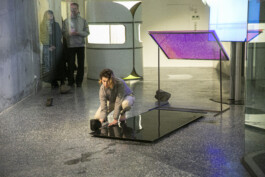
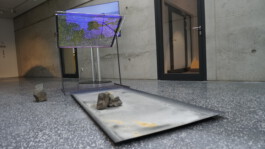
The work "Confluence" is a contemporary report. It starts in Lapland, where the threatened glacier landscape slowly disappears. Through the filming and surviving process, its portrait gets conserved. The construction of a landscape model continues in the exhibition space. A cinematic diorama presses the vastness into a cramped space.

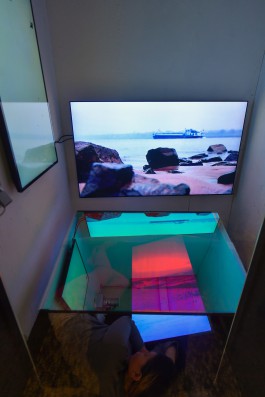
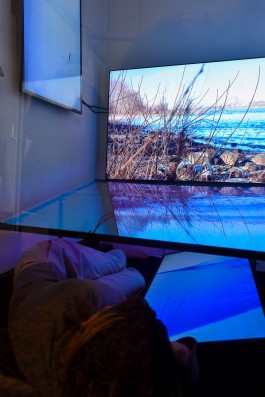
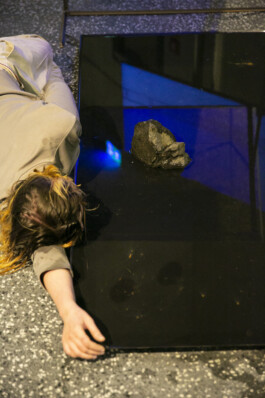
As a deconstructed screen diorama "Confluence" is playing with false perspectives. The spectator finds itself with the performing artist in a reflection of desirable landscapes. An arctic gaze awakes the nostalgia in times of global warming. – Installation at the Rundgang Kunstakademie Düsseldorf 2019


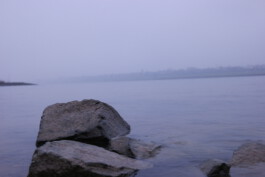
The title "Confluence" comes from the meteorological phenomenon when two streams merge into one. The variations of the work came two different biotopes in the interior space. On the one hand there are the recordings from the regional floodplain of the Rhine river and on the other hand the Finnish polar landscape, which interrupt each other in the video channels. In both constellations a model is developed in a showcase. As a deconstructed diorama, "Confluence" plays with false perspectives and a reflection in the glass filter and the water mirror. Here the spectator feels the reproduced images, while the original natural sources continue disappearing.


with generous support from SIGMA Audio Visual Systems Düsseldorf

The work "Confluence" is a contemporary report. It starts in Lapland, where the threatened glacier landscape slowly disappears. Through the filming and surviving process, its portrait gets conserved. The construction of a landscape model continues in the exhibition space. A cinematic diorama presses the vastness into a cramped space.

As a deconstructed screen diorama "Confluence" is playing with false perspectives. The spectator finds itself with the performing artist in a reflection of desirable landscapes. An arctic gaze awakes the nostalgia in times of global warming. – Installation at the Rundgang Kunstakademie Düsseldorf 2019


The title "Confluence" comes from the meteorological phenomenon when two streams merge into one. The variations of the work came two different biotopes in the interior space. On the one hand there are the recordings from the regional floodplain of the Rhine river and on the other hand the Finnish polar landscape, which interrupt each other in the video channels. In both constellations a model is developed in a showcase. As a deconstructed diorama, "Confluence" plays with false perspectives and a reflection in the glass filter and the water mirror. Here the spectator feels the reproduced images, while the original natural sources continue disappearing.


with generous support from SIGMA Audio Visual Systems Düsseldorf
Daria Nazarenko (*1993) is moving between film stills and subcultures. By staging bodies and cameras, she highlights the hidden dynamics of social life. Sometimes hybrid dance films happen close to vitrines full of porcelain gestures and site-specific performances. Her work has been shaped by long-term engagement with Senegal since 2021, including participation in programmes at École des Sables, where she explored collaborative and non-Western approaches to performance and embodied knowledge within postcolonial contexts.
Nazarenko has developed projects in institutional and independent contexts, including Museum Folkwang (Essen), PACT Zollverein (Essen), Kunstsammlung K21 (Düsseldorf), tanzhaus nrw (Düsseldorf), and international presentations in Paris and Moscow. She has also realised site-specific interventions in urban and performative settings, integrating archival and oral knowledge structures into spatial installations. She studied Design and time-based arts at Burg Giebichenstein University of Art and Design and graduated from the class of Dominique Gonzalez-Foerster at Kunstakademie Düsseldorf, 2024. In the latest interdisciplinary run of the Hospitalfield Residency (UK) 2026 she examined the fluidity of class systems in between timelines and migration.
Daria Nazarenko (*1993) is moving between film stills and subcultures. By staging bodies and cameras, she highlights the hidden dynamics of social life. Sometimes hybrid dance films happen close to vitrines full of porcelain gestures and site-specific performances. Her work has been shaped by long-term engagement with Senegal since 2021, including participation in programmes at École des Sables, where she explored collaborative and non-Western approaches to performance and embodied knowledge within postcolonial contexts.
Nazarenko has developed projects in institutional and independent contexts, including Museum Folkwang (Essen), PACT Zollverein (Essen), Kunstsammlung K21 (Düsseldorf), tanzhaus nrw (Düsseldorf), and international presentations in Paris and Moscow. She has also realised site-specific interventions in urban and performative settings, integrating archival and oral knowledge structures into spatial installations. She studied Design and time-based arts at Burg Giebichenstein University of Art and Design and graduated from the class of Dominique Gonzalez-Foerster at Kunstakademie Düsseldorf, 2024. In the latest interdisciplinary run of the Hospitalfield Residency (UK) 2026 she examined the fluidity of class systems in between timelines and migration.