When You Start Forgetting How to Cross the Streets You Immediately Unlearn Borders
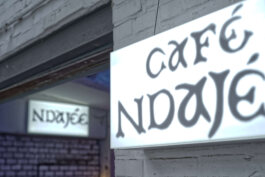
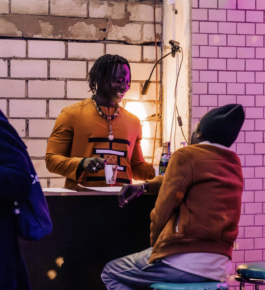
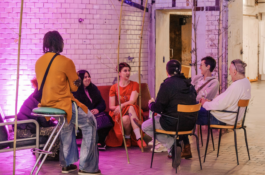
On September 17th, 2025, we opened the doors of our Ndajée Café at Weltkunstzimmer for the first time. Before that, Moïse and I spent weeks walking the neighborhood, hand-packing 300 letters and slipping them into mailboxes. Each one was a quiet invitation. When the doors finally opened, people came: neighbors sharing Café Touba, our Senegalese pepper coffee, falling into conversation about art, about migration, about what neighborhood actually means.
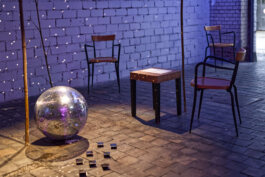
The café takes its name and its spirit from the street where Moïse used to live in Dakar. Ndajée means "the encounter" in Wolof. Finding the right aesthetic for it mattered as much as anything we said, something that could actually invite the neighborhood in, not just display itself to them. Later our inbox filled with feedback, reviews, well-meaning advice on how to "make it in Germany." Direct, honest, sometimes surprising. The café invited visitors for four weeks and it was never just a café. It was a question, posed in cups and conversations: what happens when a neighborhood gathers not around consumption, but around belonging?
Before arriving in Germany we brought that a question to Dakar: How to preserve immaterial heritage. Here we sat with griots, the storytellers and keepers of oral history in West African tradition, and through them, with the teachings of Amadou Bamba. We went to listen, not to take. What we were after was real exchange, not borrowing someone else's culture and calling it our own. Later we translated what we heard into movement.
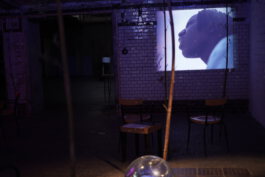
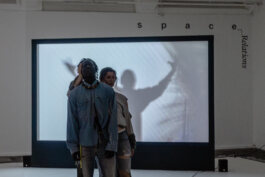
When you start forgetting how to cross the streets, you immediately unlearn borders is a two-channel video performance born from a simple observation: the idea of borders between continents is nothing more than a staging of power politics. Music travels without a visa. Dance needs no passport. Stories weave into one another, change shape, live on inside cultures that were never their own, as if they'd never belonged to just one place. In the performance we experiment with unlearning itself. We forget how to cross a street, and in that forgetting a new choreography appears, one that overrides the rulebook and hands power back to bodies, wherever they find themselves.
Both works, the café and the performance, reach toward the same truth: the lines we're told divide us are softer than we've been made to believe.

SHIELDING
Practices and conceptual approaches in which bodies, intentionally or involuntarily, become shields. Bodies take on an ambivalent and controversial status in the process: on the one hand, they serve as protection or as a buffer against others – other people or symbolic sites – and express resistance. On the other, they become weapons as well as shields when they intervene, on the ground as well as politically, in wars and conflict but also activism. Situated in a broader intellectual context, the focus on shielding connects to various debates in which corporeality and embodiment in current socio-political contexts are re-evaluated. It also follows the question of how body-based research from the performative arts can enter into dialogue with other fields of knowledge and application to help understand the aesthetic, sociopolitical, ethical and legal dimension of the body.
text by Sandra North and Janez Janza


In the show SHIELDLESSNESS at Gemeinde Köln 2025 and later on at WELTKUNSTZIMMER Düsseldorf, Daria Nazarenko team up with Moïse Daouda Fall, bringing their different backgrounds to their collaboration: Moïse Douda Fall dances krump and is interested in lighting and stage technology, while Daria Nazarenko, an interdisciplinary artist, explores subcultural community practices through performance.
With greatest thanks for their participation in the artistic research:
Ahmadou Sissokho, Famara Mané, Ousmane Sonko, Zarko, Elhadji Babacar Faye, Alassane Sissokho
Photographed by Luisa Flügge and Pia Koop
SIGMA Audiovisual Systems
ORAFOL
Li Germany
Jung Papier

When You Start Forgetting How to Cross the Streets You Immediately Unlearn Borders
On September 17th, 2025, we opened the doors of our Ndajée Café at Weltkunstzimmer for the first time. Before that, Moïse and I spent weeks walking the neighborhood, hand-packing 300 letters and slipping them into mailboxes. Each one was a quiet invitation. When the doors finally opened, people came: neighbors sharing Café Touba, our Senegalese pepper coffee, falling into conversation about art, about migration, about what neighborhood actually means.
The café takes its name and its spirit from the street where Moïse used to live in Dakar. Ndajée means "the encounter" in Wolof. Finding the right aesthetic for it mattered as much as anything we said, something that could actually invite the neighborhood in, not just display itself to them. Later our inbox filled with feedback, reviews, well-meaning advice on how to "make it in Germany." Direct, honest, sometimes surprising. The café invited visitors for four weeks and it was never just a café. It was a question, posed in cups and conversations: what happens when a neighborhood gathers not around consumption, but around belonging?
Before arriving in Germany we brought that a question to Dakar: How to preserve immaterial heritage. Here we sat with griots, the storytellers and keepers of oral history in West African tradition, and through them, with the teachings of Amadou Bamba. We went to listen, not to take. What we were after was real exchange, not borrowing someone else's culture and calling it our own. Later we translated what we heard into movement.
When you start forgetting how to cross the streets, you immediately unlearn borders is a two-channel video performance born from a simple observation: the idea of borders between continents is nothing more than a staging of power politics. Music travels without a visa. Dance needs no passport. Stories weave into one another, change shape, live on inside cultures that were never their own, as if they'd never belonged to just one place. In the performance we experiment with unlearning itself. We forget how to cross a street, and in that forgetting a new choreography appears, one that overrides the rulebook and hands power back to bodies, wherever they find themselves.
Both works, the café and the performance, reach toward the same truth: the lines we're told divide us are softer than we've been made to believe.


SHIELDING
Practices and conceptual approaches in which bodies, intentionally or involuntarily, become shields. Bodies take on an ambivalent and controversial status in the process: on the one hand, they serve as protection or as a buffer against others – other people or symbolic sites – and express resistance. On the other, they become weapons as well as shields when they intervene, on the ground as well as politically, in wars and conflict but also activism. Situated in a broader intellectual context, the focus on shielding connects to various debates in which corporeality and embodiment in current socio-political contexts are re-evaluated. It also follows the question of how body-based research from the performative arts can enter into dialogue with other fields of knowledge and application to help understand the aesthetic, sociopolitical, ethical and legal dimension of the body.
text by Sandra North and Janez Janza

In the show SHIELDLESSNESS at Gemeinde Köln 2025 and later on at WELTKUNSTZIMMER Düsseldorf, Daria Nazarenko team up with Moïse Daouda Fall, bringing their different backgrounds to their collaboration: Moïse Douda Fall dances krump and is interested in lighting and stage technology, while Daria Nazarenko, an interdisciplinary artist, explores subcultural community practices through performance.
With greatest thanks for their participation in the artistic research:
Ahmadou Sissokho, Famara Mané, Ousmane Sonko, Zarko, Elhadji Babacar Faye, Alassane Sissokho
Photographed by Luisa Flügge and Pia Koop
SIGMA Audiovisual Systems
ORAFOL
Li Germany
Jung Papier