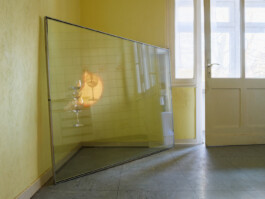
performative installation in the frame of Empty Spaces Project – What are we living for? Curated by Mara Sporn
Two potential inhabitants of an empty house open questions about the future treatment of corporeality during a process of global isolation. Our mobile, digital society has been forced into domestication in 2020 by the pandemic circumstances. The question of a space in which we can move with ease and which routines determine our everyday life became essential.

Households started to reflect their existence and functionality unconsciously, driven by shaken certanties and global chain reactions. How we can open restricted spaces? In every living room there is usually a small wall cupboard with inherited dishes. There you will find a service of your parents, grandparents, great-grandparents.
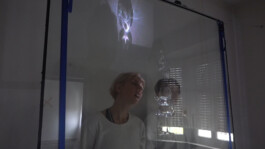
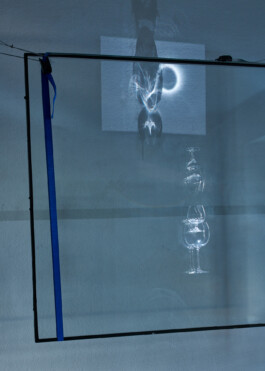
Traditions are preserved like everyday routines. Crystal wine glasses stack into each other. But which side of the glasses is polished and which is dusty? The glass sculptures are placed in the old kitchen and in the salon. A solar eclipse is projected on the glass generations, so that in the course the light and the form break in the half glass. In this collaboration with dancer Kati Masami Menze, shadowy aspects of everyday routines deserve a stage.
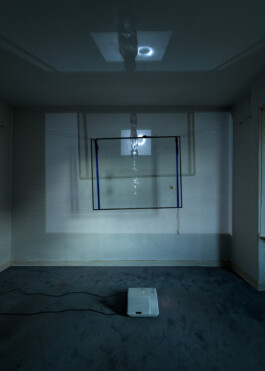
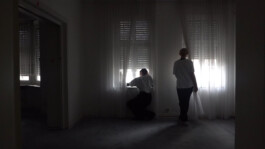
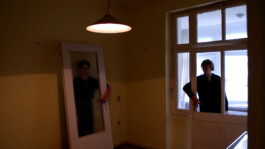
all photos by Kai Werner Schmidt
performative installation in the frame of Empty Spaces Project – What are we living for? Curated by Mara Sporn
Two potential inhabitants of an empty house open questions about the future treatment of corporeality during a process of global isolation. Our mobile, digital society has been forced into domestication in 2020 by the pandemic circumstances. The question of a space in which we can move with ease and which routines determine our everyday life became essential.


Households started to reflect their existence and functionality unconsciously, driven by shaken certanties and global chain reactions. How we can open restricted spaces? In every living room there is usually a small wall cupboard with inherited dishes. There you will find a service of your parents, grandparents, great-grandparents.
Traditions are preserved like everyday routines. Crystal wine glasses stack into each other. But which side of the glasses is polished and which is dusty? The glass sculptures are placed in the old kitchen and in the salon. A solar eclipse is projected on the glass generations, so that in the course the light and the form break in the half glass. In this collaboration with dancer Kati Masami Menze, shadowy aspects of everyday routines deserve a stage.



all photos by Kai Werner Schmidt
Daria Nazarenko (*1993) is moving between film stills and subcultures. By staging bodies and cameras, she highlights the hidden dynamics of social life. Sometimes hybrid dance films happen close to vitrines full of porcelain gestures and site-specific performances. Her work has been shaped by long-term engagement with Senegal since 2021, including participation in programmes at École des Sables, where she explored collaborative and non-Western approaches to performance and embodied knowledge within postcolonial contexts.
Nazarenko has developed projects in institutional and independent contexts, including Museum Folkwang (Essen), PACT Zollverein (Essen), Kunstsammlung K21 (Düsseldorf), tanzhaus nrw (Düsseldorf), and international presentations in Paris and Moscow. She has also realised site-specific interventions in urban and performative settings, integrating archival and oral knowledge structures into spatial installations. She studied Design and time-based arts at Burg Giebichenstein University of Art and Design and graduated from the class of Dominique Gonzalez-Foerster at Kunstakademie Düsseldorf, 2024. In the latest interdisciplinary run of the Hospitalfield Residency (UK) 2026 she examined the fluidity of class systems in between timelines and migration.
Daria Nazarenko (*1993) is moving between film stills and subcultures. By staging bodies and cameras, she highlights the hidden dynamics of social life. Sometimes hybrid dance films happen close to vitrines full of porcelain gestures and site-specific performances. Her work has been shaped by long-term engagement with Senegal since 2021, including participation in programmes at École des Sables, where she explored collaborative and non-Western approaches to performance and embodied knowledge within postcolonial contexts.
Nazarenko has developed projects in institutional and independent contexts, including Museum Folkwang (Essen), PACT Zollverein (Essen), Kunstsammlung K21 (Düsseldorf), tanzhaus nrw (Düsseldorf), and international presentations in Paris and Moscow. She has also realised site-specific interventions in urban and performative settings, integrating archival and oral knowledge structures into spatial installations. She studied Design and time-based arts at Burg Giebichenstein University of Art and Design and graduated from the class of Dominique Gonzalez-Foerster at Kunstakademie Düsseldorf, 2024. In the latest interdisciplinary run of the Hospitalfield Residency (UK) 2026 she examined the fluidity of class systems in between timelines and migration.